
TEA: Definition, History, Production Process, Types, Blends, Tisanes, Brands & Service Procedure
TEA – Camellia Sinensis
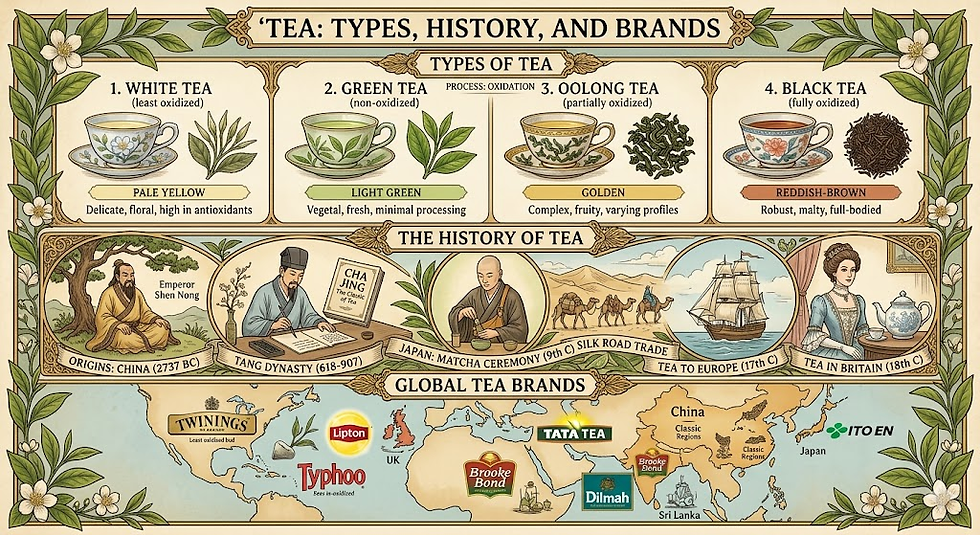
After water, tea is the most widely-consumed beverage in the world. It has a cooling, slightly bitter flavour which many enjoy. Tea or Camellia Sinensis is an evergreen plant that grows mainly in tropical and sub-tropical climates. There are two principal varieties used-the small leaved China plant( Camelia sinesis sinensis) and the large leaved Assam plant (Camelia sinesis assamica). Tea plants require at least 50 inches of rainfall a year and prefer acidic soils. High-quality tea plants are cultivated at elevations of up to 1,500 metres (4,900 ft); at these heights, the plants grow more slowly and acquire a better flavour. A tea plant will grow into a tree if left undisturbed, but cultivated plants are pruned to waist height for ease of plucking. The names popular around the world are derived from Chinese character of the word tea. One is tea and the other is cha.
*Tea/Camellia Sinensis naturally contains a stimulant called THEINE.
History of Tea:
Tea originated in China around 3000BC ago and was discovered, according to legend, by Emperor Shen Nong when tea leaves accidentally fell into boiling water. Initially used for medicinal purposes, tea became a popular daily beverage during the Tang Dynasty. From China, tea spread to Japan and other Asian countries, where it became deeply rooted in culture and rituals. European traders introduced tea to Europe in the 16th century, and it gained immense popularity in England. Large-scale tea cultivation in India began under British rule in the 19th century, especially in Assam and Darjeeling. Today, tea is one of the most widely consumed beverages worldwide, valued for its taste, health benefits, and cultural importance.
Producing Region/Countries:
In 1835 the English East India Company, upon discovery of an indigenous variety of Camellia Sinensis in Assam, India, established their first experimental tea plantation there. It was largely unsuccessful at the beginning. In 1856 varieties of tea from the Yunnan and Keemun provinces of China were introduced in Darjeeling, India, and soon thrived. Some of the most prized and expensive Indian black teas come from this high mountain region. One year later tea was cultivated in Ceylon (Sri Lanka). Luckily, for tea growers and consumers, a fungus wiped out the coffee crop in Ceylon in 1869, then its' main export. This opened the door to increased tea production and exportation. By the early 1900's tea was being cultivated in Java, Sumatra, Indonesia, Kenya and other parts of Africa . Presently, the United States has been added to the list of tea producers as there is one plantation in North Carolina.
Production/ Manufacturing Process of Tea:
There are two methods of producing black tea:
Traditional Orthodox Method.
CTC (Cut, Tear and Curl) Method.
Traditional Orthodox Method:
In this process the tea is processed in five stages:
Withering (Drying): The plucked leaves are weighed and then spread out thinly or evenly on special racks for about 24 hours, where it is allowed to lose 50% of its moisture by evaporation.
Rolling: The leaves are put through rolling machines that break up the leaf cells. In this process the natural juices are released to come in contact with air.
Fermentation: In this stage oxidation of tea tanin takes place. The rolled leaves are spread out on racks in cool humid room for about 3 hours, during this period the leaves become bright, coppery red because of absorption of oxygen and also develop flavour and aroma from the enzymes present in the leaf sap.
Firing: The leaves are now fired in a current of hot, dry air for 20-30 minutes. Firing helps in stopping of fermentation and turns the leaves to black, dry and crisp.
Sifting and grading: The dry tea is sifted, graded and packed into foil lined tea chests and sealed to protect the tea from moisture and odour.
CTC (Cut, Tear and Curl) Method:
The leaves are processed through a special machine which cuts, tears and curls the withered fall in a single process during the beginning of fermentation stage. The CTC leaves have pellet- appearance and always broken in size and have browner leaf than orthodox method. It produces ong liquor with less flavour.
TEA MAKING PROCESS:
In the process of tea making, the leaves from the tea plant are transformed into the dried leaves for brewing tea. The types of tea are differentiated by the processing they undergo.
Plucking: The flushes that include a terminal bud and two other young leaves are picked from tea plant typically twice a year during early spring and early summer. Picking is usually done by hand but occasionally mechanical picking is also in use.
Withering: The tea leaves begin to wither soon after picking. The withering process is used to remove excess moisture from the leaves. The leaves are put under the sun or left in breezy room to pull moisture out of the leaves.
Fermentation/Oxidation: Withered leaves are subjected to oxidation. In order to promote and quicken oxidation, the leaves may be bruised by shaking and tossing in a bamboo tray or rolled over wheels. During oxidation, the leaves are left on their own in a climate-controlled room where they progressively turn darker. The chlorophyll in the leaves is enzymatically broken down, and its tannins are released. The producer may choose when the oxidation should be stopped, which depends on the desired qualities in the final product.
Firing: This process is accomplished to stop the fermentation at desired oxidation levels. The tea leaves are moderately heated, thus deactivating their oxidative enzymes and removing unwanted scents in the leaves, without damaging the flavour of the tea.
Rolling/Shaping: The tea leaves are then rolled into spirals, kneaded and rolled into pellets, or tied into balls, cones, and other elaborate shapes. This rolling action also causes some of the sap, essential oils, and juices inside the leaves to ooze out, which further enhances the taste of the tea.
Drying: This process is carried out to prepare the leaves for sale. It can be done in a number of ways including panning, sunning, air drying, or baking.
Ageing/Curing: While not always required, some teas require additional ageing, secondary fermentation to develop their complex flavours. Flavoured teas are manufactured in this stage by spraying the leaves with aromas and flavours.

Types of Tea:

Types of Tea:
White Tea - White tea may refer to one of several styles of tea which generally feature young or minimally processed leaves of the Camellia sinensis plant. White teas are lightly processed to prevent oxidation and further fermentation. Because that, white tea has the delicate flavour and also retains high levels of the chemicals responsible for its health benefits. 0.01% Oxidation
Yellow Tea - Yellow teas are a lightly oxidized version of tea where, after withering, the leaves are lightly steamed allowing for enzymatic oxidation, the chemical process where flavonoids breakdown resulting in the browning of the leaves and the development of the flavour. This is a rather labour intensive process that requires special training, which limits the production capacity for this type of tea. 0.01% Oxidation
Green Tea - Green tea is a type of tea where oxidation is stopped very early in the manufacturing process. The oxidation is stopped either through steaming, as is common practice in Japan, or through heating over a fire or in a stove. By stopping the oxidation early, the leaves remain green. Typically this is less than 10% oxidation.
Blue Tea/Oolong Tea - Providing some of the greatest variety in style, taste, and appearance, oolong teas are partially oxidized, anywhere from 10-80%, before being heated to stop oxidation.
Black Teas - Known as red tea by the Chinese for the colour of the brewed liquor, black tea is the most common type of tea consumed in the United States as it is typically the base for iced tea. Black tea is a more fully oxidized version of the tea leaves, ranging anywhere from 50-100% oxidized. Some of the teas best known in the west are black tea based blends including English Breakfast and Earl Grey.
Mature Teas or Pu-erh Tea - The only type of teas that are actually fermented are pu-erh. 100% oxidization and are fermented after completing the manufacturing process. This is truly a unique tea that reflects the history of where it was founded. Pu-erh was historically made in the Yunnan province of China and traded with Tibet and Mongolia for horses.
Scented Tea - Scented or Flower tea is either green or white tea that has been infused with certain flowers, which impart a delicate and interesting taste, and of course a wonderful aroma.

Herbal Teas are also called Tisane
Herbal teas called tisanes are beverages made from the infusion or decoction of herbs, spices, or other plant material in hot water. Herbal teas should not be confused with true teas (e.g., black, green, white, yellow, oolong), which are prepared from the cured leaves of the tea plant, Camellia sinensis),
Like beverages made from true teas, herbal teas can be served hot or cold.
Example – Chamomile Tea, Cinnamon Tea, Lemon Grass Tea, Ginger Tea, Eucalyptus Tea, Fennel Tea, etc
Items required during service:
Salver lined with a cloth.
Teapot.
Pot of hot water.
Tea strainer.
Milk jug.
Sugar bowl with tongs (Teaspoon for granulated sugar. Spoon or tongs not necessary if sugar comes in sachets).
Pieces of lemon on a quarter plate.
Tea Blends
Blend | Characteristics |
Assam | A strong, full-bodied, and malty flavoured drink; it is usually taken with milk and is ideal for breakfast. |
Darjeeling | Thin, light coloured, delicate flavour, astringent tannic characteristics. Best enjoyed without milk; however, a little milk may be added if preferred. Black tea may be taken with lemon. It is known as the ‘champagne of teas’. It is suitable blend during afternoon and evening tea time. |
Earl grey | It is a blend of Darjeeling and China tea, flavoured with oil extracted from the rind of Bergamot orange. It is best taken black or with lemon. |
Jasmine tea | Green or white tea dried with jasmine, it is taken without milk to appreciate the flavour. |
Rose | Mixed with rose petals during oxidation, it has a delicate rose flavour. It may be served with or without milk. |
Lotus | Green tea is mixed with fragrant stamens of lotus, allowing it to absorb the lotus flavour. Vietnam is known for lotus tea. It is taken without milk. |
Mint | Green tea is flavoured with the herb mint. This tea is very popular in the Middle-east and in desert areas of North Africa. It is best enjoyed without milk. |
Lapsang Souchong | Chinese black tea, smoke dried over pinewood fire, it gives a smoky flavour. It is taken black. |
Sri Lanka | Pale golden tea with good flavour, it is served with lemon or milk. |
Spices | Tea flavoured with spices such as cinnamon, cloves, cardamom, black pepper, fennel, nutmeg, cassia, anise, mace, ginger, and so on. It is popular in India and the Middle-east. Served with milk. It is sold as masala chai. |
Tea Brands
Indian Brands | International Brands |
Tata Tea | Lipton |
Brooke Bond (Red Label & Taj Mahal) | Tetley |
Wagh Bakri Tea | Twinings Tea |
Society Tea | Dilmah |
Darjeeling Tea | Yorkshire Tea |
PURCHASE OF TEA:
There are different means to purchase tea:
Bulk(leaves).
Tea bags.
String and tag.
Envelopes.
Instant – tea granules.
Rules to make Tea:
Water should be lime-free. Tap water makes tea cloudy.
Rinse the teapot well with boiling water before putting the tea in. The requirements are: One teaspoon of tea per person + one for the pot (depends upon the quality of the tea).
Pour the water onto the tea just as it reaches boiling point, taking the pot to the kettle.
Infusion time is 3-5 minutes; after which, the flavour does not improve. The infusion becomes bitter if boiled longer. It should be brewed and not stewed or boiled.
Just before serving, stir the tea in the teapot with a spoon. Use a strainer.
Water should be 95° C (just below boiling point), before you pour it over the tea leaves.
Service of Tea:
COVER: Teacup (180 ml), saucer, teaspoon in front of the guest.
TRAY: Teapot, jug with hot water, milk jug, sugar basin with sugar tongs, tea strainer, slop basin.
SERVICE: Generally on the left side, next to the host / hostess who serves the guest, unless requested by the guest
Comments