
NON ALCOHOLIC BEVERAGES: REFRESHING, NOURISHING & STIMULATING BEVERAGES, TEA, COFFEE & COCOA, LOCAL BEVERAGES
Introduction to Beverages:
A 'Beverage' is the term which refers to all kinds of potable drinks which have thirst-quenching, refreshing, stimulating and nourishing qualities.

Non-Alcoholic Beverages:
Non alcoholic Beverage is
A potable Liquid
Has no ethyl alcohol
Or
Has less than 0.5% alcohol by volume (abv)
Have thirst-quenching, refreshing, stimulating and nourishing qualities.
Types:

Nourishing Beverages:
Definition: Nourishing beverages are a type of non-alcoholic Beverages which are consumed to provide nutrients to the body.
Purpose: To combat fatigue, enhance cognitive function, and improve productivity.
Types:

Malted Beverages:
Definition: A type of Non-alcoholic nourishing beverage made from malted barley, wheat, or grains.
Production Process: Soak grains, germinate, dry, and roast.
Varieties:
Malted Milk: Powdered barley, wheat, and milk.
Malted Milkshakes: Malt, ice cream, milk.
Malt Beer: Non-alcoholic, malty, often carbonated.
Malted Hot Drinks: Made with malted milk powder or malt extract.
Brands:
Indian - Horlicks, Bourn Vita, Boost etc.
International - Ovaltine, Milo, Carnation Malted Milk Ovaltine.
Milkshakes:
Definition: Milkshake is a type of non-alcoholic Nourishing beverage made from milk, ice cream, flavorings, and sometimes sweeteners or syrups.
Production Process: Combine milk, ice cream, and desired flavorings in a blender until smooth and frothy.
Varieties:
Classic Milkshake
Fruit Milkshake
Chocolate Milkshake
Specialty Milkshakes:
Examples: Vanilla, Chocolate, Strawberry, Oreo Cookie, Peanut Butter, Mint Chocolate Chip etc.
Brands: Keventers, Shakeshack, Five Guys, Mcdonald's.
Squashes:
Definition: a type of non-alcoholic nourishing beverage made from fruits, vegetables, or herbs, typically diluted with water before consumption
Varieties:
• Fruit Squashes: Concentrated fruit extracts mixed with sugar and water.
• Cordials: Similar to fruit squashes but may include additional flavourings and botanicals.
Examples: Orange Squash, Lemon Cordial
International Brands: Head, Tecnifibre, Dunlop, Wilson, and Karakal
Indian Brands: Mapro, Mala's, and Supreem.
Hot Chocolate:
Definition: Hot chocolate is a type of non-alcoholic Nourishing warm beverage made from cocoa powder or chocolate and milk, often sweetened and flavoured with vanilla or other spices.
How it is made: Blend cocoa powder or chocolate with milk, heat, and stir until smooth.
Examples: Swiss Miss, Nestlé's Hot Cocoa, Cadbury Hot Chocolate, Starbucks Hot Chocolate
Juices:
Definition: Non-alcoholic nourishing beverage made from fruits or vegetables, typically extracted through pressing, blending, or juicing processes. Production Process: Extract juice from fruits or vegetables, filter, and sometimes pasteurize. Varieties:
• Fresh Juices
• Packed Juices
Examples: Orange Juice, Tomato Juice, ABC Juice Brands:
Indian - Real Fruit Juices, Tropicana, Paper Boat
International - Ocean Spray, V8, Langers
Refreshing Beverages:
Definition: A type of Non-alcoholic beverage that provide a sensation of rejuvenation, relief from thirst and to make up for the fluid loss (due to perspiration).
Purpose: To provide hydration, Sensory Pleasure, and social Enjoyment
Types:

Aerated Beverages:
Definition: A carbonated, non-alcoholic refreshing beverage produced through the infusion of carbon dioxide gas, providing effervescence and a refreshing taste.
Production Process: Mix sweeteners, flavourings, and carbon dioxide with water under pressure.
Brands: Sprite, 7UP, Coca Cola, Mountain Dew
Non-Aerated Beverages:
Definition: a type of Non-alcoholic refreshing beverage formulated from various
Ingredients and characterized by the absence of carbonation.
Production Process: Blend selected ingredients, filter, and package for consumption.
Brands: Maaza, Fruity, Slice, Calpico
Example: Nimbu Paani, Slice
Mocktails:
Definition:
• A type of Non-alcoholic refreshing beverage A mixture of two or more non-alcoholic beverage
• Made by a particular method and recipe Served in a specific glassware usually has a garnish.
Methods:
1. Build up (Top Up, Layering, Muddling)
2. Shaking Blending
3. Stirring
Examples - Virgin Mojito, Virgin Pina Colada
Water:
Definition:
Non-alcoholic refreshing beverage which is
· Transparent
· Odourless
· Colourless
· Tasteless
Types:
• Mineral Water
• Soda
• Spring Sparkling
• Tonic
• Infused
Brands - Evian, Dasani, Perrier, Fiji Water, Aquafina
Stimulating beverages:
Definition: Stimulating beverages are a type of Non-Alcoholic Beverage formulated with ingredients that contains stimulants such as Caffeine, which enhance alertness, energy levels, and mental focus.
Types:
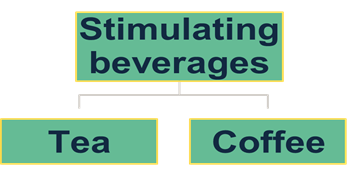
TEA – Camellia Sinensis
After water, tea is the most widely-consumed beverage in the world. It has a cooling, slightly bitter flavour which many enjoy. Tea or Camellia Sinensis is an evergreen plant that grows mainly in tropical and sub-tropical climates. There are two principal varieties used-the small leaved China plant( Camelia sinesis sinensis) and the large leaved Assam plant (Camelia sinesis assamica). Tea plants require at least 50 inches of rainfall a year and prefer acidic soils. High-quality tea plants are cultivated at elevations of up to 1,500 metres (4,900 ft); at these heights, the plants grow more slowly and acquire a better flavour. A tea plant will grow into a tree if left undisturbed, but cultivated plants are pruned to waist height for ease of plucking. The names popular around the world are derived from Chinese character of the word tea. One is tea and the other is cha.
*Tea/Camellia Sinensis naturally contains a stimulant called THEINE.
History of Tea:
Tea originated in China around 3000BC ago and was discovered, according to legend, by Emperor Shen Nong when tea leaves accidentally fell into boiling water. Initially used for medicinal purposes, tea became a popular daily beverage during the Tang Dynasty. From China, tea spread to Japan and other Asian countries, where it became deeply rooted in culture and rituals. European traders introduced tea to Europe in the 16th century, and it gained immense popularity in England. Large-scale tea cultivation in India began under British rule in the 19th century, especially in Assam and Darjeeling. Today, tea is one of the most widely consumed beverages worldwide, valued for its taste, health benefits, and cultural importance.
Producing Region/Countries:
In 1835 the English East India Company, upon discovery of an indigenous variety of Camellia Sinensis in Assam, India, established their first experimental tea plantation there. It was largely unsuccessful at the beginning. In 1856 varieties of tea from the Yunnan and Keemun provinces of China were introduced in Darjeeling, India, and soon thrived. Some of the most prized and expensive Indian black teas come from this high mountain region. One year later tea was cultivated in Ceylon (Sri Lanka). Luckily, for tea growers and consumers, a fungus wiped out the coffee crop in Ceylon in 1869, then its' main export. This opened the door to increased tea production and exportation. By the early 1900's tea was being cultivated in Java, Sumatra, Indonesia, Kenya and other parts of Africa . Presently, the United States has been added to the list of tea producers as there is one plantation in North Carolina.
Production/ Manufacturing Process of Tea:
There are two methods of producing black tea:
Traditional Orthodox Method.
CTC (Cut, Tear and Curl) Method.
Traditional Orthodox Method:
In this process the tea is processed in five stages:
Withering (Drying): The plucked leaves are weighed and then spread out thinly or evenly on special racks for about 24 hours, where it is allowed to lose 50% of its moisture by evaporation.
Rolling: The leaves are put through rolling machines that break up the leaf cells. In this process the natural juices are released to come in contact with air.
Fermentation: In this stage oxidation of tea tanin takes place. The rolled leaves are spread out on racks in cool humid room for about 3 hours, during this period the leaves become bright, coppery red because of absorption of oxygen and also develop flavour and aroma from the enzymes present in the leaf sap.
Firing: The leaves are now fired in a current of hot, dry air for 20-30 minutes. Firing helps in stopping of fermentation and turns the leaves to black, dry and crisp.
Sifting and grading: The dry tea is sifted, graded and packed into foil lined tea chests and sealed to protect the tea from moisture and odour.
CTC (Cut, Tear and Curl) Method:
The leaves are processed through a special machine which cuts, tears and curls the withered fall in a single process during the beginning of fermentation stage. The CTC leaves have pellet- appearance and always broken in size and have browner leaf than orthodox method. It produces ong liquor with less flavour.
TEA MAKING PROCESS:
In the process of tea making, the leaves from the tea plant are transformed into the dried leaves for brewing tea. The types of tea are differentiated by the processing they undergo.
Plucking: The flushes that include a terminal bud and two other young leaves are picked from tea plant typically twice a year during early spring and early summer. Picking is usually done by hand but occasionally mechanical picking is also in use.
Withering: The tea leaves begin to wither soon after picking. The withering process is used to remove excess moisture from the leaves. The leaves are put under the sun or left in breezy room to pull moisture out of the leaves.
Fermentation/Oxidation: Withered leaves are subjected to oxidation. In order to promote and quicken oxidation, the leaves may be bruised by shaking and tossing in a bamboo tray or rolled over wheels. During oxidation, the leaves are left on their own in a climate-controlled room where they progressively turn darker. The chlorophyll in the leaves is enzymatically broken down, and its tannins are released. The producer may choose when the oxidation should be stopped, which depends on the desired qualities in the final product.
Firing: This process is accomplished to stop the fermentation at desired oxidation levels. The tea leaves are moderately heated, thus deactivating their oxidative enzymes and removing unwanted scents in the leaves, without damaging the flavour of the tea.
Rolling/Shaping: The tea leaves are then rolled into spirals, kneaded and rolled into pellets, or tied into balls, cones, and other elaborate shapes. This rolling action also causes some of the sap, essential oils, and juices inside the leaves to ooze out, which further enhances the taste of the tea.
Drying: This process is carried out to prepare the leaves for sale. It can be done in a number of ways including panning, sunning, air drying, or baking.
Ageing/Curing: While not always required, some teas require additional ageing, secondary fermentation to develop their complex flavours. Flavoured teas are manufactured in this stage by spraying the leaves with aromas and flavours.

Types of Tea:

Types of Tea:
White Tea - White tea may refer to one of several styles of tea which generally feature young or minimally processed leaves of the Camellia sinensis plant. White teas are lightly processed to prevent oxidation and further fermentation. Because that, white tea has the delicate flavour and also retains high levels of the chemicals responsible for its health benefits. 0.01% Oxidation
Yellow Tea - Yellow teas are a lightly oxidized version of tea where, after withering, the leaves are lightly steamed allowing for enzymatic oxidation, the chemical process where flavonoids breakdown resulting in the browning of the leaves and the development of the flavour. This is a rather labour intensive process that requires special training, which limits the production capacity for this type of tea. 0.01% Oxidation
Green Tea - Green tea is a type of tea where oxidation is stopped very early in the manufacturing process. The oxidation is stopped either through steaming, as is common practice in Japan, or through heating over a fire or in a stove. By stopping the oxidation early, the leaves remain green. Typically this is less than 10% oxidation.
Blue Tea/Oolong Tea - Providing some of the greatest variety in style, taste, and appearance, oolong teas are partially oxidized, anywhere from 10-80%, before being heated to stop oxidation.
Black Teas - Known as red tea by the Chinese for the colour of the brewed liquor, black tea is the most common type of tea consumed in the United States as it is typically the base for iced tea. Black tea is a more fully oxidized version of the tea leaves, ranging anywhere from 50-100% oxidized. Some of the teas best known in the west are black tea based blends including English Breakfast and Earl Grey.
Mature Teas or Pu-erh Tea - The only type of teas that are actually fermented are pu-erh. 100% oxidization and are fermented after completing the manufacturing process. This is truly a unique tea that reflects the history of where it was founded. Pu-erh was historically made in the Yunnan province of China and traded with Tibet and Mongolia for horses.
Scented Tea - Scented or Flower tea is either green or white tea that has been infused with certain flowers, which impart a delicate and interesting taste, and of course a wonderful aroma.

Herbal Teas are also called Tisane
Herbal teas called tisanes are beverages made from the infusion or decoction of herbs, spices, or other plant material in hot water. Herbal teas should not be confused with true teas (e.g., black, green, white, yellow, oolong), which are prepared from the cured leaves of the tea plant, Camellia sinensis),
Like beverages made from true teas, herbal teas can be served hot or cold.
Example – Chamomile Tea, Cinnamon Tea, Lemon Grass Tea, Ginger Tea, Eucalyptus Tea, Fennel Tea, etc
Items required during service:
Salver lined with a cloth.
Teapot.
Pot of hot water.
Tea strainer.
Milk jug.
Sugar bowl with tongs (Teaspoon for granulated sugar. Spoon or tongs not necessary if sugar comes in sachets).
Pieces of lemon on a quarter plate.
Tea Blends
Blend | Characteristics |
Assam | A strong, full-bodied, and malty flavoured drink; it is usually taken with milk and is ideal for breakfast. |
Darjeeling | Thin, light coloured, delicate flavour, astringent tannic characteristics. Best enjoyed without milk; however, a little milk may be added if preferred. Black tea may be taken with lemon. It is known as the ‘champagne of teas’. It is suitable blend during afternoon and evening tea time. |
Earl grey | It is a blend of Darjeeling and China tea, flavoured with oil extracted from the rind of Bergamot orange. It is best taken black or with lemon. |
Jasmine tea | Green or white tea dried with jasmine, it is taken without milk to appreciate the flavour. |
Rose | Mixed with rose petals during oxidation, it has a delicate rose flavour. It may be served with or without milk. |
Lotus | Green tea is mixed with fragrant stamens of lotus, allowing it to absorb the lotus flavour. Vietnam is known for lotus tea. It is taken without milk. |
Mint | Green tea is flavoured with the herb mint. This tea is very popular in the Middle-east and in desert areas of North Africa. It is best enjoyed without milk. |
Lapsang Souchong | Chinese black tea, smoke dried over pinewood fire, it gives a smoky flavour. It is taken black. |
Sri Lanka | Pale golden tea with good flavour, it is served with lemon or milk. |
Spices | Tea flavoured with spices such as cinnamon, cloves, cardamom, black pepper, fennel, nutmeg, cassia, anise, mace, ginger, and so on. It is popular in India and the Middle-east. Served with milk. It is sold as masala chai. |
Tea Brands
Indian Brands | International Brands |
Tata Tea | Lipton |
Brooke Bond (Red Label & Taj Mahal) | Tetley |
Wagh Bakri Tea | Twinings Tea |
Society Tea | Dilmah |
Darjeeling Tea | Yorkshire Tea |
PURCHASE OF TEA:
There are different means to purchase tea:
Bulk(leaves).
Tea bags.
String and tag.
Envelopes.
Instant – tea granules.
Rules to make Tea:
Water should be lime-free. Tap water makes tea cloudy.
Rinse the teapot well with boiling water before putting the tea in. The requirements are: One teaspoon of tea per person + one for the pot (depends upon the quality of the tea).
Pour the water onto the tea just as it reaches boiling point, taking the pot to the kettle.
Infusion time is 3-5 minutes; after which, the flavour does not improve. The infusion becomes bitter if boiled longer. It should be brewed and not stewed or boiled.
Just before serving, stir the tea in the teapot with a spoon. Use a strainer.
Water should be 95° C (just below boiling point), before you pour it over the tea leaves.
Service of Tea:
COVER: Teacup (180 ml), saucer, teaspoon in front of the guest.
TRAY: Teapot, jug with hot water, milk jug, sugar basin with sugar tongs, tea strainer, slop basin.
SERVICE: Generally on the left side, next to the host / hostess who serves the guest, unless requested by the guest
COFFEE:
Coffee is a brewed drink prepared from roasted coffee beans of the coffee plant.
They are seeds of coffee cherries that grow on trees in over 70 countries. Green (unroasted) coffee is one of the most traded agricultural commodities in the world. Evergreen coffee plants grow in tropical and subtropical regions. Due to its caffeine content, coffee can have a stimulating effect in humans. Today, coffee is one of the most popular beverages worldwide. It is thought that the energizing effect of the coffee bean plant was first recognized in Yemen in Arabia and the north east of Ethiopia, and the cultivation of coffee first expanded in the Arab world.
Coffee berries, which contain the coffee bean, are produced by several species of small evergreen bush of the genus Coffea.
The two most commonly grown are the highly regarded
Coffee Arabica - Best quality coffee with a smooth, aromatic flavour. Beans are oval, slightly larger, and contain lower caffeine than Robusta.
Coffee Robusta - Stronger, more bitter taste and higher caffeine content. Beans are smaller, rounder, and higher yielding than Arabica.
There is a third variety called the Coffea Liberica , slightly inferior but also popular. It has large, irregularly shaped beans with unique flavour. It is less commonly grown and lower in quality compared to Arabica and Robusta.
Coffee Producing Region/Countries
Brazil is the largest producer of coffee and the second largest coffee-consuming nation. Its coffee sector employs over five million people and contributes 40% of the world’s total coffee supply.
Vietnam is the second largest producer of coffee in the world, accounting for 16% of global production. It is the main producer of Robustas. Coffee production in Vietnam creates jobs for more than 1 million workers.
Colombia is the second-largest supplier of Arabica coffee after Brazil. 2,4 million Colombians economically depend on coffee production (25% of the country’s rural population).
Indonesia is the world’s second-largest exporter of Robusta. Indonesian coffee is produced by an estimated 1.5 million smallholder farmers. Ethiopia is the largest coffee producer in Africa. The EU is the primary market, accounting for 60% of sales. Ethiopia’s 1.2 million smallholder farmers contribute over 90% of production.
Processing of Coffee
Harvesting the Coffee Cherries - The fruit, called the coffee cherry, turns a bright, deep red when it is ripe and ready to be harvested.
Processing the Cherries –
The Dry Method is the age-old method of processing coffee, and still used in many countries where water resources are limited. The freshly picked cherries are simply spread out on huge surfaces to dry in the sun
The Wet Method removes the pulp from the coffee cherry after harvesting so the bean is dried with only the parchment skin left on. First, the freshly harvested cherries are passed through a pulping machine to separate the skin and pulp from the bean.
Fermentation- the beans are transported to large, water-filled fermentation tanks.
Drying the Beans - If the beans have been processed by the wet method, the pulped and fermented beans must now be dried to approximately 11% moisture to properly prepare them for storage.
Hulling - Hulling machinery removes the parchment layer (endocarp) from wet processed coffee. Hulling dry processed coffee refers to removing the entire dried husk — the exocarp, mesocarp and endocarp — of the dried cherries.
Grading and Sorting is done by size and weight, and beans are also reviewed for color flaws or other imperfections.
Exporting the Beans - The milled beans, now referred to as green coffee, are loaded onto ships in either jute or sisal bags loaded in shipping containers, or bulk-shipped inside plastic-lined containers.
Roasting the Coffee -Roasting transforms green coffee into the aromatic brown beans that we purchase in our favourite stores or cafés. After roasting, the beans are immediately cooled either by air or water. Roasting is generally performed in the importing countries because freshly roasted beans must reach the consumer as quickly as possible.
Light Roast – Mild flavour, light brown, preserves aroma.( 193°C)
Medium Roast – Balanced flavour, medium brown, slightly stronger taste.( 205°C)
Dark Roast – Strong, bitter flavour, dark brown/black, loses some original aroma. (218°C)
Grinding Coffee- The objective of a proper grind is to get the most flavor in a cup of coffee. How coarse or fine the coffee is ground depends on the brewing method.
Types of Coffee
Freshly Ground Coffee beans.
Instant coffee - If the coffee is to be instant, it is brewed with water in huge percolators after the grinding stage. An extract is clarified from the brewed coffee and sprayed into a large cylinder. As it falls downward through this cylinder, it enters a warm air stream that converts it into a dry powder.
Decaffeinating - If the coffee is to be decaffeinated, it is now processed using either a solvent or a water method. In the first process, the coffee beans are treated with a solvent (usually methylene chloride) that leaches out the caffeine. If this decaffeination method is used, the beans must be thoroughly washed to remove traces of the solvent prior to roasting.
Different styles of Coffee preparations available in Restaurants/Hotels
Style of Coffee preparation | Description |
Espresso | Coffee of Italian origin, brewed by expressing or forcing a small amount of nearly boiling water under pressure through finely ground coffee beans. |
Caffè Macchiato | Sometimes called espresso macchiato, an espresso coffee drink with a small amount of milk. |
Cappuccino | An espresso-based coffee drink that originated in Italy, traditionally prepared with double espresso and steamed milk foam. |
Doppio | A double shot of espresso, pulled using twice the amount of ground coffee as a single shot. It contains about twice the volume (typically 60ml) and twice the caffeine of a standard espresso. |
Ristretto | A "restricted" espresso shot made with the same amount of coffee as a standard espresso but half the amount of water. It is shorter, more concentrated, sweeter, and less bitter than a regular espresso. |
Caffe Latte | A coffee drink made with espresso and steamed milk. The term as used in English is a shortened form of the Italian caffè latte, which means "milk coffee". |
Cafe Americano | A style of coffee prepared by adding espresso to hot water, giving a similar strength but different flavor from regular drip coffee. |
Caffè Mocha | Also called mocaccino, a chocolate-flavored variant of a caffè latte. |
Affogato | An Italian coffee-based dessert. Usually a scoop of vanilla gelato or ice cream topped or "drowned" with a shot of hot espresso. |
Frappuccino | A trademarked brand of Starbucks Corporation for a line of iced, blended coffee drinks. Consists of coffee or crème base blended with ice and other various ingredients, usually topped with whipped cream and sauces. |
Speciality/Liqueur Coffee | A coffee brew with an ounce shot of liqueur. Served in a clear, pre-heated liqueur coffee glass with coffee and cream separated. Liqueur is added first with raw cane sugar, then strong filter coffee, then chilled whipped cream poured over a cold spoon to float on top. Sugar helps cream float. Examples:
|
Coffee Brands:
Indian Coffee Brands | International Coffee Brands |
Araku Coffee | Starbucks (USA) |
Bru Coffee | Nescafé (Switzerland) |
Continental Coffee | Lavazza (Italy) |
Blue Tokai Coffee Roasters | Illy (Italy) |
Levista Coffee | Tim Hortons (Canada) |
Various Methods of Making Coffee:
Instant method: As the name suggests, it is the quickest and the easiest method of making coffee. In this method, soluble coffee solids are mixed with hot water. It can be made just before it is served by pouring freshly boiled water over the measured instant coffee powder. The coffee dissolves instantly. It can be served with milk. Sugar is offered separately. This method is suitable for making coffee in small and large quantities. Regular and decaffeinated styles are available.
Saucepan or jug method: This method can be adopted for the preparation of small and large quantity of coffee. A measured quantity of coarsely ground coffee is placed in a saucepan or jug, and freshly boiled water is poured over it and covered with a lid. It is allowed to infuse for few minutes and is then strained. It is served with hot or cold milk. Sugar is offered separately.
La cafetière method (plunger): This method is simple and is the most suitable for making coffee in a small quantity. The cafetière equipment has a glass container with a lip and a lid with a plunger unit. The lid holds the plunger in a position. In this method, the measured quantity of medium coffee grind is placed and freshly boiled water added to the coffee. It is then stirred and covered with the lid and plunger unit and allowed to infuse. At the same time, the coffee grains will rise to the top of the liquid. After this, if the plunger is moved slightly, the coffee grains will fall to the bottom of the container. The plunger unit is pushed down the glass container before serving. The infusion time normally takes 3-5 minutes and depends on the temperature of water. It is served with or without milk. Sugar is offered separately.
Percolator method: The percolator consists of a pot with a small chamber at its bottom, close to a heat source. A vertical tube connects the bottom chamber with top of the percolator where a measured quantity of coarse ground coffee is placed on the filter. Water is poured up to the water mark level into the chamber near the heat source. When the equipment is switched on, water heats up steadily and starts boiling. Hot water rises through the pipe, infuses the ground coffee, seeps through the filter and drips to the bottom chamber and gets mixed with water in it. The hot water with coffee in the bottom chamber continues to rise up and infuse the coffee on the filter and the cycle continues. As the brew continuously seeps through ground coffee, the overall temperature of the liquid reaches boiling point. At this stage, the percolator automatically stops and the coffee is ready to use. When this infusion time has been completed, the coffee liquid no longer infuses with the coffee ground but is held in the main body of the percolator at a serving temperature of 82°C (180°F). This method is now rarely used and is fading away.
Vacuum infusion method (cona): This method of making coffee is also termed 'cona' coffee. The cona machine has two bowls-one set over the other and a filter piece made of metal or plastic and a tube connecting two bowls (see Fig. 19.3). The bowls are made of glass or metal. The upper bowl is usually made of glass. In this method, the lower bowl is filled with hot water to the marked level. The upper bowl is then set over the lower bowl properly. The filter is placed in the upper bowl, ensuring it is placed correctly. The measured quantity of ground coffee is added to the upper bowl according to the quantity of water taken. The machine is switched on. The water in the lower bowl reaches boiling point and rises up the tube into upper bowl and mixes with the ground coffee. At this it is stage, important to stir the mixture gently with a spoon to ensure all the grounds infuse with the liquid and cap formation is prevented. On reducing the heat, the coffee liquid passes back into the lower bowl, leaving the spent coffee grounds in the upper bowl. The upper bowl and filter are then washed and kept ready for reuse. The coffee in the lower bowl is ready for use. It should be served at approximately 82°C. This method takes approximately seven minutes. This method is suitable when coffee is made fresh in small quantities. Most coffee shops have cona equipment.
Filter method: This is the traditional method of making coffee. In south India, especially in Tamil Nadu, every house has a small coffee filter to make filter coffee. Filter coffee can be made in individual cups or in bulk. The coffee filter equipment has two pieces of containers with the filter unit (perforated plate) in between. The equipment should be thoroughly cleaned and rinsed with hot water. The containers and filter must be properly positioned. Freshly ground coffee is measured and placed in the filter which is at the bottom of the top container and freshly boiled water is poured in the top container. Infusion takes place and the coffee liquid falls into the lower container. Filter papers may also be used to avoid passage of the ground coffee to the lower container but this will depend on the type of coffee grind used. The coffee is held in the bottom container and served with milk. This method takes approximately 10 minutes. This method is used in function catering. The coffee filter equipment used for function catering is available on hire. Electronic units are also available for this purpose. Cold water is poured into a container and brought to boiling point and then dripped onto the ground coffee. This method produces excellent coffee.
Pour through' filter method: This method is suitable in commercial operations. Most coffee houses and popular restaurants use electric filter coffee machine to make coffee (see that the filter is thoroughly cleaned/new filter paper is placed.) Before the filter machine is used, one should ensure Freshly drawn water is poured to the level indicated on the jar. Fresh ground coffee, which normally comes in vacuum sealed packet sufficient for a single brew, is added. When the machine is switched on, hot water infuses with the coffee powder and filters into the serving container. It takes approximately three minutes for each brew. There are many designs of coffee filter machine with different outputs available in the market and the operator can choose according to his/her requirement.
Individual filter method: This is a convenient and an economical method of making one cup of filter coffee. Individual filter is a plastic, disposable unit, bought with the required amount of coffee already sealed in the base of the filter (see Fig. 19.5). One filter is sufficient for a cup and the entire filter is thrown away after single use. The advantage of this method is that every cup may be made fresh to order. It satisfies customers When making a cup of coffee by this method, an individual filter is placed in a cup. Freshly boiled water is then poured into the individual filter to the required level. The liquid then infuses with the ground coffee and drips into the cup. A lid should be placed over the water in the filter to help retain the temperature. The time of making this coffee is approximately three to four minutes as they receive absolutely fresh coffee.
Still set: Still set consists of water boilers, milk heaters, and coffee filters set up in a still room or coffee making area. The measured quantity of coffee grind is placed in the filter unit of a container and heated water from the boiler is directed to the coffee grind and allowed to infuse. The infused coffee drips down the container and is held at right temperature till required. Coffee is made with or without the addition of milk, which is kept warm in the double jacketed milk container.
Espresso method: An espresso machine is used to make this type of coffee. Hot steam is passed through very fine ground coffee and is allowed to infuse under pressure. It makes excellent coffee quickly in individual cups. This method of making coffee is quicker compared to any other method and individual cups of coffee are made in seconds. Some machines have the capacity of making 300-400 cups of coffee per hour. This method has its origins in Italy. If coffee is served black, it is called espresso. It is served in a small cup. If piping hot milk is added to the black coffee, the espresso becomes cappuccino. The operator must follow the manufacturer's instruction for the same.
Turkish or Egyptian method: In this method, water is boiled with sugar in a special copper pot having a long handle. The finely ground coffee is added and stirred and the grounds are allowed to settle before serving. The copper pot is placed on a stove with required quantity of water and is allowed to boil with sugar. The finely ground heavily roasted mocha beans are stirred in (one heaped teaspoon coffee powder per person) and taken off from the stove allowing the grounds to settle. It is again brought to a boil and allowed to settle and sprinkled with a little cold water to settle the grounds completely and then covered with lid. It is served in small cups. It may be flavoured with vanilla pod or cardamom during preparation.
The following points should be kept in mind while making coffee:
Ensure all equipment used to make coffee is clean.
Always use freshly roasted and ground coffee, which is stored in airtight containers. It is advisable to roast beans in limited quantity and grind according to requirement.
Use the right type of grind for the type of coffee-making method.
Use freshly drawn and freshly boiled water at a temperature of 92-96°C to retain the aroma of the coffee. Do not use boiling water.
Measure the quantity of coffee carefully according to the quantity of water to be used (300-360 g per five litres of water).
Add hot water to the grind and allow infusing. Water infuses the ground coffee to extract flavour and colour. Infusion time depends on the type of grind in use.
Strain, if necessary, and keep at 82°C.
Strain milk in the milk jug before adding to the coffee.
Add hot milk, if required.
Once prepared, coffee should be served at the earliest (within half an hour) as the aroma deteriorates if the coffee is allowed to stand for long.
Faults in Coffee
During the preparation of coffee, it may result in bitter, weak, and flat coffee for the reasons mentioned in this section.
Issue | Causes |
Bitter coffee |
|
Weak coffee |
|
Flat coffee |
|
COCOA
The Cocoa plant is a small tropical tree originally grown in South America and commercially grown in West Africa. It needs a good soil, low altitude and high rainfall to grow.
The fruit of the tree which grows on the branches as well as main trunk is used form cocoa and chocolate. The fruit is a large pod 4 inches-12 inches in length, about 4inde diameter and has a hard leathery rind containing 25-75 seeds in five distinct rows embed soft pulp.
The various species of cocoa are Criollo, Forastero. The cocoa comes from countries like West Africa, Brazil and America, although the biggest producer is West Africa.
PROCESSING OF COCOA:
Fermentation: The ripe cocoa pods are collected, split open and the beans and pulp surrounding is scooped out and fermented under controlled conditions. Sweat boxes are used for fermentation where temperature is allowed to rise to 40°-50°C (104-122°F).
Reasons for fermentation:
To kill the germs, prevent germination of the seed and decomposition of the bean.
To encourage the enzyme reaction reducing bitterness and developing flavour.
The beans absorb the liquid from the fermenting sugary pulp, which is then converted into alcohol and then to acetic acid. The fermentation is stopped as soon as the mass of beans passes into the acid stage. If fermentation is allowed to continue, it would develop unpleasant flavours and odours in the beans.
Drying: The drying is done by passing through a mechanical chamber or by exposing in the sun for two to three days, occasionally turning them over.
Roasting: In this stage separation of shell from the bean takes and moisture is lost. Roasting also assists in developing of flavour and aroma
Winnowing: It means removal of shell; it is done by passing through a series of rollers and sieves. Thus, deshelled beans obtained are called nibs.
Dutch Processing: In these processes, nibs are immersed in alkaline solution which further develops colour and flavour. After drying, the nibs may be re-roasted to correct the moisture content.
Grinding: The nibs are ground into very small particles to produce cocoa and cocoa butter.
Extraction: The cocoa mass is fed into felt lined steel pans fitted with a removable perforated lid and is subjected to hydraulic press, some of the fat is forced through filter-cloths leaving behind solid residue called press cake. This is removed from the pan, cooled to set colour, pulverized powdered and then sieved. This is mixed with small amount salt and vanilla flavouring to make Cocoa powder.
CHOCOLATE
Processing of plain chocolate
Mixing: In this process the cocoa mass is thoroughly mixed with powdered sugar in blending kettles. In order to obtain standard product, the fat content is controlled.
Refining: This is done by passing the mixture through a series of five heavy steel rollen This helps in converting the chocolate to a smooth paste by reducing the size of non-fa particles. This stage exposes the particles to the air reducing moisture content, partially evaporating volatile substances and lightening the colour of the mixture.
Conching: Conching is the mechanical agitation of the chocolate mass, with additional cocoa butter, if necessary at a temperature of 60°-70°C (140-158°F), as it further expose the mass to the air, removing further undesirable volatile substances and helps to develop flavour.
Standardizing: The chocolate may be incorporated with additional flavours before being run. off and set into moulds as bars and slabs. The product is then also known "Couverture".
The Processing of Milk Chocolate: This is similar to that of making plain chocolate except that milk crumb is added at the refining stage and the conching is at a lower temperature but for longer time. (Milk crumb is a mixture of specially prepared condensed milk and chocolate ma which has been reduced to a powder form.)
Storage Challenges of Tea, Coffee, and Cocoa
Coffee is the most delicate among the three when it comes to storage. Roasted and ground coffee loses its volatile aromatic substances quickly. These substances are responsible for much of its flavor and aroma. Once they escape, the coffee tastes flat and stale. Tea and cocoa have comparatively fewer storage problems. However, all three products become stale after long storage. This happens because the flavor components fade away, leaving behind less volatile, bitter tannin flavors.
Key storage issues:
Coffee loses aromatic substances easily, especially after roasting and grinding.
Tea and cocoa are more stable but still lose freshness over time.
Staleness in all three comes from loss of flavor and leftover bitter tannins.
Recommended Storage Times
Below are the general storage time guidelines for different forms of tea, coffee, and cocoa chocolate.
Product Category | Form / Packaging | Shelf Life |
Tea | Loose tea | 4 weeks |
Packed or tea bags | 8 to 16 weeks | |
Coffee | Roasted beans, vacuum packed | 52 weeks |
Roasted beans, loose | 2 weeks | |
Ground coffee, vacuum packed | 40 weeks | |
Ground coffee, loose | 1 week | |
Instant coffee (unopened) | 12 weeks | |
Cocoa and Chocolate | Cocoa chocolate powder | 12 weeks |
Chocolate slab | 12 weeks |
Simple Storage Tips
To keep these products fresh for as long as possible, follow these basic tips:
Store coffee in an airtight container away from light, heat, and moisture.
Buy coffee in small amounts if buying loose ground coffee, since it lasts only 1 week.
Keep tea in a cool, dark place inside a sealed tin or pouch.
Cocoa powder and chocolate slabs should be kept in a dry place with a stable temperature.
Avoid storing any of these near strong-smelling foods, as they absorb odors easily.
LOCAL BEVERAGES:
India has a rich variety of traditional local beverages that are not just refreshing but also offer health benefits. These drinks are deeply connected to regional climates, harvest seasons, and festivals. Most are made from easily available ingredients like yogurt, fruits, spices, and herbs. They help cool the body in summer, improve digestion, or provide energy during festivities.
Below is a closer look at eight popular local beverages:
Lassi
A classic Punjabi drink made by blending yogurt with water, sugar, or salt. Sweet lassi is often flavored with cardamom, rose water, or saffron, and sometimes topped with cream or nuts. Salty lassi includes roasted cumin powder and black salt. It is rich in probiotics, helps digestion, and is a natural body cooler.
Jal Jeera
A tangy, spicy, and refreshing cumin water. It is made by mixing roasted cumin powder, black salt, mint, ginger, green chilies, tamarind, and lemon juice with water. Jal jeera is commonly served as an appetizer drink before meals. It stimulates digestion, relieves bloating, and is a popular street drink in North India.
Aam ka Panna
A summer drink made from raw green mangoes. The mangoes are boiled, peeled, and blended with sugar or jaggery, black salt, roasted cumin, mint, and cardamom. It is diluted with water and served chilled. Aam ka panna prevents heatstroke, dehydration, and replenishes lost vitamins. It tastes sweet, sour, and spicy all at once.
Thandai
A rich, creamy, and aromatic milk-based drink. It contains a blend of fennel seeds, cardamom, poppy seeds, almonds, cashews, pistachios, saffron, and rose petals – all ground into a paste and mixed with cold milk. Thandai is famously associated with the Holi festival. Some variations also include bhang (cannabis) during special occasions. It provides cooling energy and is packed with nutrients.
Buttermilk (Chaas)
A light, thin yogurt drink made by diluting yogurt with water and churning it. It is seasoned with salt, roasted cumin powder, ginger, green chilies, and curry leaves or coriander. Chaas is a common daily drink in Gujarat, Rajasthan, and South India. It is low in fat, aids digestion, neutralizes acidity, and prevents dehydration during hot weather.
Kokum
A deep purple or red drink made from the dried rinds of the kokum fruit (Garcinia indica). The rinds are soaked in water, then mixed with sugar or jaggery, black salt, and cumin. Kokum is a popular summer drink in Maharashtra, Goa, and coastal Karnataka. It has a naturally sweet-sour taste, feels cooling, and helps reduce sunstroke and hunger pangs.
Panagam
A traditional South Indian drink, especially made during Ram Navami. It is a simple mix of jaggery dissolved in water, with dry ginger powder, cardamom, black pepper, and sometimes lemon juice. Panagam is served without milk or curd. It prevents fatigue, cools the body, and provides instant energy from jaggery. The spices also help with digestion and reduce nausea.
Sherbet
A sweet, concentrated syrup drink diluted with water or milk. Common sherbet flavors include rose (gulab), lemon (nimbu), sandalwood (chandan), mango, and khus (vetiver). Rose sherbet is a favorite in North India and during Ramadan. The syrup is homemade or store-bought, mixed with chilled water and sometimes chia seeds. Sherbet relieves thirst, cools the body, and can be customized with herbs like mint or basil seeds for extra health benefits.
These local beverages are easy to make at home and are much healthier than packaged soft drinks. Each one carries a unique taste and cultural story from different parts of India.
NON ALCOHOLIC BEVERAGES: REFRESHING, NOURISHING & STIMULATING BEVERAGES


Comments